


Orin J. Robinson Jr.
I am a senior research associate at the Cornell Lab of Ornithology. The overarching theme of my research is using and developing quantitative tools to make use of large ecological data sets in order to learn about avian population ecology. Ultimately, the goal is to apply what we have learned to wildlife conservation and management. Of particular interest is how we can use multiple data sets together to better inform management decisions.
Latest Publications
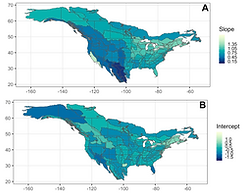
We compared population‐trend estimates derived independently from two major continental‐scale monitoring programs for North American breeding birds—the structured North American Breeding Bird Survey (BBS) and the semi-structured eBird —across 5,577 species × Bird Conservation Region combinations. While both datasets carry substantial uncertainty the two surveys agreed strongly on the direction of trends: only ~1.3 % of combinations produced significantly opposing trend directions, and the median difference in trend point‐estimates (BBS minus eBird) was just −0.02 % per year. Agreement was stronger for estimates judged to be of high credibility, and alignment varied by species, taxonomic group and region. The authors conclude that although survey methodology, coverage, and analytical frameworks differ, the two platforms yield remarkably consistent signals of change—and the paper highlights contexts and caveats for interpreting and integrating trend estimates across multiple monitoring sources. Ornithological Aplications

Here we leverage large-scale citizen‐science data to assess whether volunteer‐contributed observations can reliably produce migration timing (chronology) information for waterfowl, and compare these derived migration chronologies with those from professional monitoring surveys. Citizen science datasets show strong alignment with professional survey data in terms of timing of arrival, peak migration, and departure for multiple species, suggesting that these volunteer datasets can serve as a viable supplement (though not full replacement) for formal survey programs in habitat management and monitoring contexts. We also discuss caveats—such as spatial/temporal biases in citizen observations, potential detectability issues, and the need for appropriate analytical filtering and calibration—before recommending how managers might integrate citizen‐science chronologies into decision‐making frameworks. Ornithological Applications